
- By Nosheen Kanwal
- October 7, 2025
- No Comments
Web Design Trends: Predictions for 2026
A Global Analysis of How Web Design Trends Evolved in 2025 and Where It Is Heading Next
Website design has never been as influential or as fast-moving as it is today. The global digital ecosystem has matured, competition has sharpened, and user expectations have shifted toward speed, intelligence, aesthetics, and trust. As a result, design is no longer a decorative layer. It is the foundation of how brands communicate, convert, and scale. The year 2025 introduced a broad wave of uniformity across markets. Regions that once had distinct styles now share a baseline of clean minimalism, responsive frameworks like Bootstrap 5 and Tailwind CSS, and light performance-focused builds with conversion-focused website copies.
However, the demand for richer experiences pushed brands to experiment with 3D elements, motion design, AI-generated content variation, and localized design thinking. As 2026 approaches, companies across industries are seeking answers: What is next? Which trends will stay, which ones will fade, and what should businesses invest in? This article explains how website designs shifted in 2025 across major global markets, why the hype around it is rising, and what the next evolutionary phase looks like.
What is Web Design and Development?
Web design refers to the visual and experiential side of building a website. It includes the interface, layout, typography, colors, animations, and all elements that shape user interaction. They aim to create a structured, intuitive digital environment aligned with the brand design and identity. A modern design approach emphasizes usability, clarity, accessibility, and emotional engagement.
Web development is the technical execution behind that design. Developers translate static visuals into functioning digital systems using code, frameworks, and technologies. This involves front-end development, back-end architecture, server logic, databases, speed optimization, and security measures. The development process ensures the website works across devices, loads fast, and maintains consistent performance.
Together, web design and development form the backbone of all modern digital businesses. The combined discipline determines how visitors experience content, how customers move through the funnel, and how brands differentiate themselves in saturated markets.
Why Web Design Has a Lot of Hype in Various Markets?
Multiple psychological, economic, and technological factors drive the hype around web design. First, businesses have realized that websites have become the primary touchpoint for customer acquisition. More than 70 percent of buying journeys begin online. Brands that fail to impress instantly lose attention, interest, and authority. Clean design, strong layouts, and high speed are no longer luxuries. They are survival requirements, even search engines like Google prefer them.
Second, the global adoption of AI and automation means customers compare every website to the best experience they have ever seen. A user who browses a high-tech retail site in the USA expects the same smoothness from a dental clinic in Dubai or a consultant in Spain. These rising expectations fuel the need for better design across sectors.
Third, social media exposure has produced visual literacy among users. People subconsciously recognize poor spacing, outdated colors, unresponsive layouts, or broken UI. This increased awareness elevates pressure on businesses to invest in professional, modern, and polished design. As a result, markets across Europe, North America, and the Middle East are actively competing through visual quality.
2025 Web Design Trends Across the Globe
Web Design Trends in the UAE
The UAE leaned heavily into immersive visuals and interactive experiences in 2025, with a focus on search engine optimization. Real estate, hospitality, and luxury retail sectors led the adoption of 3D models, virtual tours, and dynamic product displays. Websites favored bold typography using elegant serifs like ‘Playfair Display’ or ‘Cinzel’ to convey opulence, dark palettes with metallic accents, and localized Arabic-English UI toggles. Many developers utilized versatile themes like ‘Salient’ or ‘Oshine’ to handle these media-heavy requirements without sacrificing elegance. AI-generated content blocks and personalized landing sections were widely adopted in premium sectors.
Web Design Trends in KSA
Saudi Arabia continued its shift toward modern minimalism, blending heritage-inspired aesthetics. Government and enterprise websites leaned toward ultra-high accessibility, fast-loading pages, and simple color systems. Typography saw a rise in bilingual-friendly fonts like ‘Cairo’ and ‘IBM Plex Sans Arabic’, which maintain visual harmony across both languages. Private businesses experimented with motion graphics, fluid scroll transitions, and bilingual experiences. Content-heavy sites frequently adopted flexible frameworks like ‘Jannah’ or ‘Sahifa’ to manage dense information hierarchies. E-commerce and creative sectors incorporated more video headers and human-centric design.
Web Design Trends in Germany
Germany maintained its reputation for functional design and high performance. Clean layouts, strict grid systems, muted color palettes, and near-perfect accessibility defined the web ecosystem in 2025. The preference for sans-serif precision was evident, with fonts like ‘Inter’, ‘Roboto’, and ‘Helvetica Now’ dominating the landscape. Heavy animations were avoided unless linked to a practical user purpose. Most businesses prioritized speed, GDPR compliant frameworks, and lightweight themes like ‘GeneratePress’ and ‘Neve’ that support sustainable code practices.
Web Design Trends in the USA
The USA adopted widespread AI personalization, A/B tested design elements, and conversion-optimized layouts. Websites featured dynamic hero sections, microinteractions, and diverse content structures for SEO and CRO. Versatile, multi-purpose themes like ‘Avada’ and ‘Divi’ remained popular for their ability to scale rapidly. The tech, SaaS, education, and retail sectors pushed for performance plus creativity. Motion design became mainstream, but always balanced with speed and usability.
Web Design Trends in the UK
The UK continued embracing clean minimalism, strong typography, and layout-driven elegance. Many brands shifted toward editorial-style designs with spacious grids, calming color tones, and controlled animations. Classic yet modern fonts like ‘Merriweather’ and ‘Libre Baskerville’ were frequently paired with minimalist themes like ‘Uncode’ to create a sophisticated digital presence. Accessibility and inclusivity were top priorities. E-commerce platforms leaned into trust-building UI and simplified checkout experiences.
How Industry Type Impacted Design Choices
What Dentists Prefer
Dental clinics focused on clean medical aesthetics. White backgrounds, soft blues, professional photography, and simple service layouts dominated. Fonts were kept approachable and legible, often utilizing ‘Open Sans’ or ‘Lato’. Booking systems needed to be visible, mobile-friendly, and effortless to use. Many clinics opted for specialized medical themes such as ‘BeClinic’ or ‘MediCenter’ to seamlessly integrate appointment functionality. The preference leaned toward trust-building design rather than creative experimentation.
What HVAC Contractors Prefer
HVAC businesses prioritized functionality. Clear service categories, strong CTAs, testimonial sections, and fast-loading pages were essential. Many adopted bold colors such as blues and reds to communicate heating and cooling themes. Heavy, reliable fonts like ‘Oswald’ or ‘Montserrat’ were used for headings to project strength. Visual clarity and technical reliability mattered more than artistic visuals, leading many to use industrial-focused themes like ‘BuildPress’ or ‘Renovate’.
What Roofers Prefer
Roofing companies leaned toward rugged, bold, and masculine design styles. High contrast color schemes, strong typography, and before-and-after galleries were common. Designers often use slab-serif fonts like ‘Roboto Slab’ to convey a sense of durability. Local SEO optimized landing pages, emergency service buttons, and quote request forms dominated the UX.
What Marketing Agencies Prefer
Marketing agencies pursued creative freedom. Animated elements, experimental typography (often using trendy fonts like ‘Syne’ or ‘Aeonik’), scroll-based transitions, and dynamic case studies became standard. Agencies preferred designs that demonstrated creativity, problem-solving ability, and visual flair. Many built upon creative frameworks like ‘Orixy’ or ‘Linoor’ to showcase portfolio items. They used their own websites as proof of capability.
What Individual Service Providers Prefer
Freelancers and consultants preferred simple, personal, and story-driven designs. Portfolio sections, testimonial carousels, and clean one-page websites became popular. Lightweight builds and personal branding elements, such as custom color palettes and expressive photographs, were essential. Minimalist portfolio themes like ‘RyanCV’ or ‘Kerge’ were widely used to keep the focus on the individual’s skills.
What Web3 Devs Prefer
Web3 developers leaned into futuristic aesthetics. Neon palettes, glitch effects, dark UI, geometric shapes, and animated 3D visuals dominated. To match the coding culture, monospaced fonts like ‘Space Mono’, ‘Fira Code’, or ‘Rajdhani’ were standard. They preferred decentralized, inspired design themes like ‘Crypton’ or ‘Nuron’ and immersive demonstrations of technical capability. Their websites mirrored the culture of innovation and blockchain architecture.
Predictions for 2026: How Web Designs Are Going to Evolve
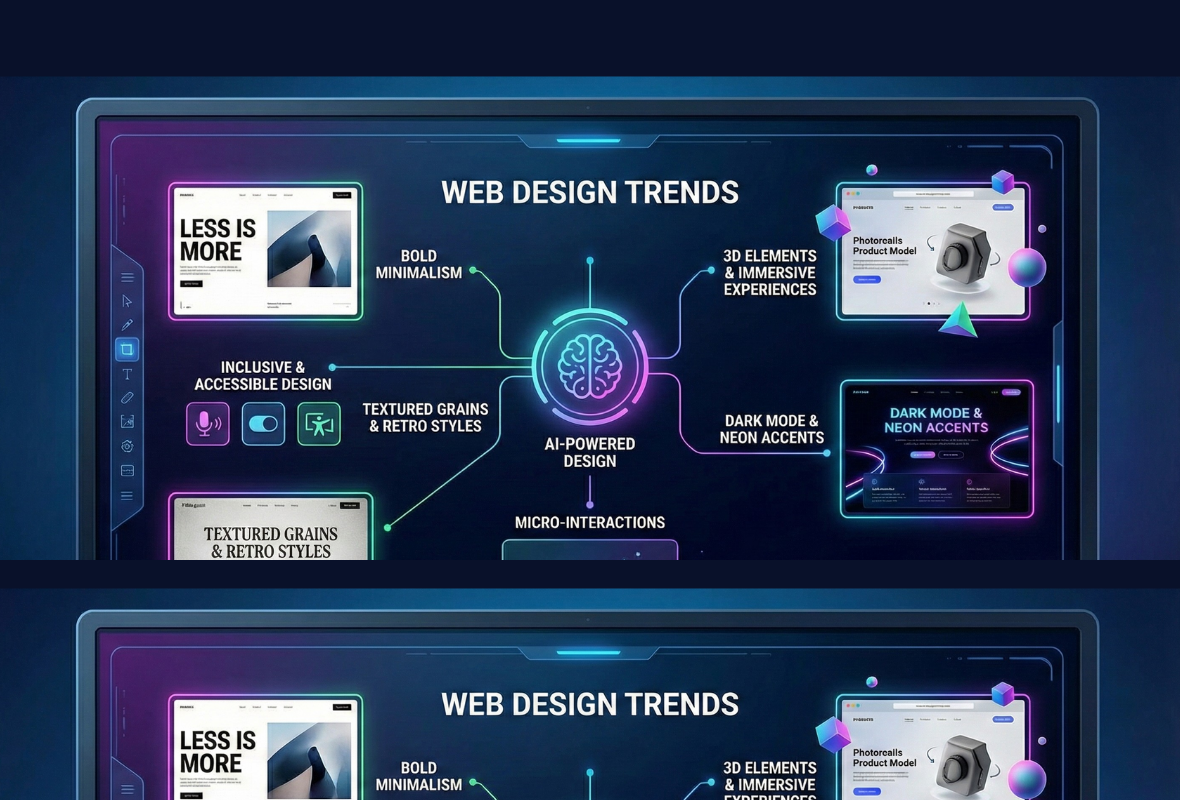
As we move toward 2026, web design will shift toward intelligence-driven experiences. AI-powered personalization will become standard, offering dynamic layouts and real-time content adjustments. 3D environments will grow, but in lighter formats that do not harm loading speed. Expect more organic shapes, soft UI, and calming interfaces designed to reduce digital fatigue.
Accessibility will become a global legal requirement instead of a best practice. Voice navigation, adaptive text, and flexible layouts will be integrated across major industries. Performance will dominate design thinking as websites adopt sustainable code and energy-efficient builds. The biggest leap will be the merging of design and data. Websites will increasingly adapt based on user behavior, device type, time of day, and geographic location, creating hyper-contextual experiences.
Design is the New Standard of Brandification
Brandification refers to the process of transforming a business into a recognizable, trusted identity. In 2026, design becomes the foundation of brandification. A brand is no longer defined solely by color palettes or logos. It is defined by the digital experience that customers interact with. The layout, flow, motion, structure, and clarity all communicate the brand’s personality.
Strong design creates instant recognition. It improves emotional connection and elevates perceived credibility. Businesses that invest in thoughtful design outperform those that treat their websites as side projects. Design consistency across devices and regions ensures the brand message remains intact. In an age of global competition, design is not a differentiator. It is the standard.
Let’s Help You Get Brandified with Best Web Design and Development Practices
If your goal is to build a powerful, globally competitive digital brand, the starting point is an intelligent and strategic website. Whether you want a minimal build for speed, an immersive build for storytelling, or a scalable system for growth, Brandified can help transform your digital identity into a high-converting asset. A well-designed website is not an expense. It is the strongest long-term investment you can make in visibility, credibility, and business growth.
Frequently Asked Questions
- What is the most important web design trend for 2026?
AI-powered personalization will lead the industry. Websites will adapt to user behavior, device type, and preference in real time.
- Will 3D design continue to grow?
Yes, but with a stronger focus on lightweight, performance-friendly versions to ensure faster load times.
- Is minimalism still relevant?
Minimalism remains the baseline strategy for clarity, usability, and speed, but designers will blend it with expressive typography and subtle interactions.
- How does regional culture affect web design?
Culture impacts color choices, typography preferences, layout styles, and language structure. Markets like the UAE and KSA prefer bold visuals, while Germany favors clean, functional design.
- How often should businesses update their website design?
A complete redesign every 2 to 3 years is ideal, with ongoing improvements every 6 months to keep up with trends and maintain relevance.